Table of Contents
- Introduction: Entering the Decade of Intelligent Transformation
- The State of AI Today
- Core AI Technologies and Their Evolving Roles by 2030
- 1. Generative AI Becomes Ubiquitous
- 2. AI Governance, Regulation, and Ethics Take Center Stage
- 3. Multimodal and General AI Systems Emerge
- 4. AI-Powered Automation Redefines the Workforce
- 5. AI for Science, Sustainability, and Society
- Obsessed With Artificial Intelligence? Bay Atlantic University is Where You Go Further
- The Road Ahead: Merging Intelligence with Purpose
- Conclusion: A Decade of Intelligent Possibilities
- Frequently Asked Questions (FAQ)
Introduction: Entering the Decade of Intelligent Transformation
Artificial Intelligence (AI) has moved from futuristic concept to everyday reality faster than anyone could have imagined. What once powered science fiction now powers daily life, from recommendation engines and chatbots to medical diagnostics and autonomous vehicles, making artificial intelligence trends impossible to ignore.
As we look ahead to the next decade, AI stands as one of the most transformative forces shaping industries, economies, and human experiences. Powered by advances in machine learning, deep learning, and data science, the next decade will redefine our work, learning, creation, and interaction with technology.
In this article, we’ll explore five major AI trends that will define the next decade, drawing on the latest insights from leading research and industry reports on artificial intelligence trends.
The State of AI Today
In just a few years, AI adoption has skyrocketed. According to McKinsey’s Technology Trends Outlook, over 78% of global organizations now use AI in at least one business function, up from 55% the previous year. Private investment in AI reached $109 billion in 2024, with generative AI alone accounting for nearly one-third of that total.
Simultaneously, global optimism toward AI is increasing. While concerns over ethics and automation persist, most experts agree that AI’s next chapter will bring massive improvements in productivity, personalization, and problem-solving.
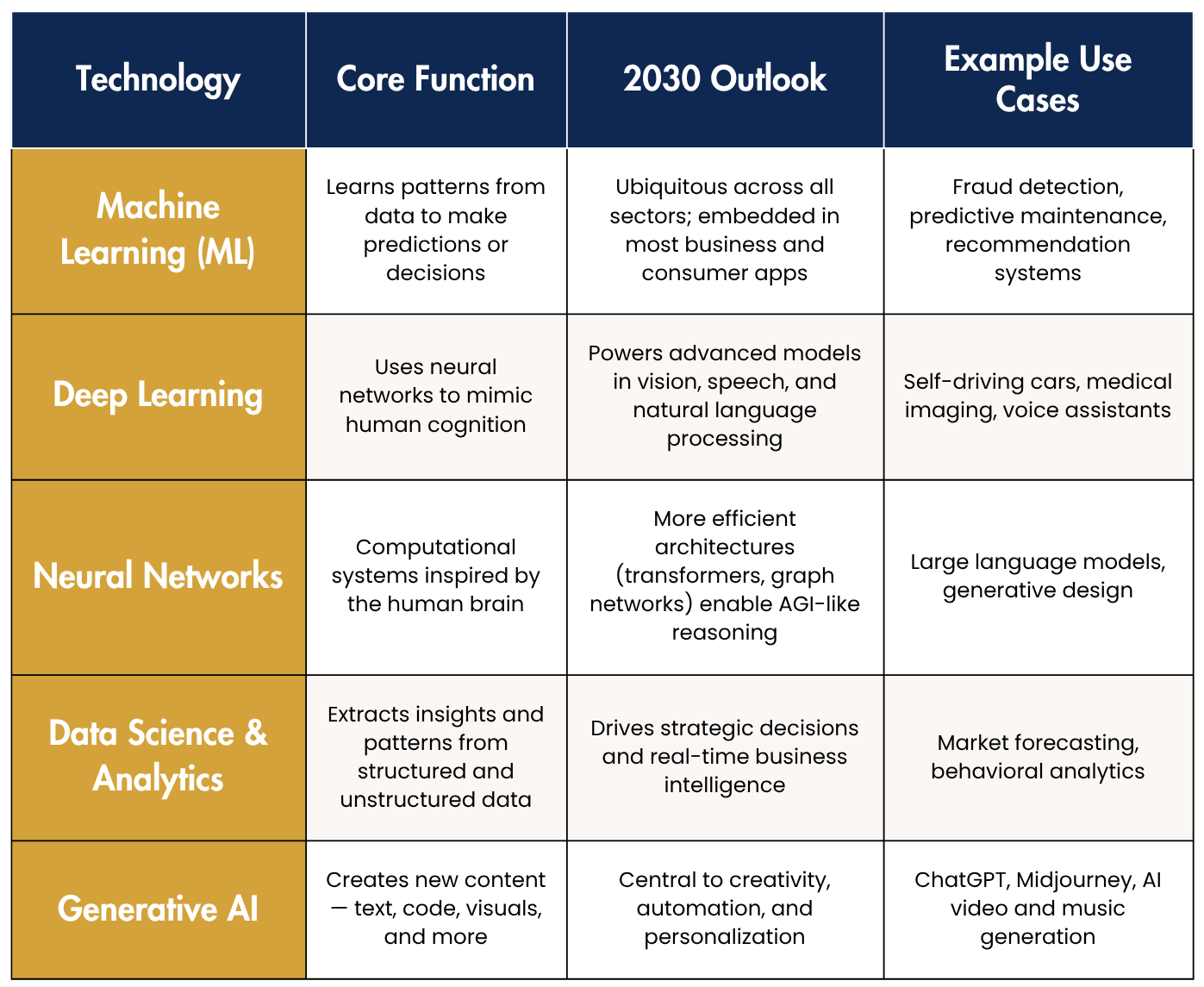
Before discussing future trends, we examine the core technologies driving this revolution.]
Core AI Technologies and Their Evolving Roles by 2030
1. Generative AI Becomes Ubiquitous
The rise of generative AI has already redefined creativity and productivity from automated content creation to code generation. But in the coming years, it won’t just be a tool for early adopters; it will be embedded into the fabric of daily work across industries. By 2030, every employee could have an AI copilot that drafts reports, suggests code, or designs presentations, transforming the way we create and communicate.
🌍 Where It’s Headed
-
Integrated Workflows: Generative models will be built directly into office suites, CRMs, and creative tools.
-
Smarter Assistants: Voice- and context-aware assistants will handle complex requests like summarizing meetings or analyzing datasets.
-
Cross-Modal Creation: Future deep learning systems will generate not only text and visuals but also music, simulations, and interactive media.
⚖️ Balancing Innovation and Responsibility
While generative AI amplifies creativity, it also raises new questions about data ownership and misinformation. Governments and companies are expected to deploy data analytics and watermarking systems to trace the origins of AI-generated content, ensuring transparency and trust.
The next phase of AI creativity won’t be about replacing people, it’ll be about giving everyone creative superpowers powered by neural networks.
2. AI Governance, Regulation, and Ethics Take Center Stage
As machine learning systems become more sophisticated, the conversation is shifting from can we build it to should we build it. Policymakers worldwide are racing to establish frameworks that ensure that AI is fair, explainable, and transparent. The European Union’s AI Act is already influencing global standards, while the U.S., Canada, and Japan are investing heavily in ethical oversight and research.
⚖️ The New AI Rulebook
-
Transparency by Design: Companies will be required to disclose how their AI systems make decisions that are creating “model cards” and “algorithmic audits.”
-
Risk-Based Classification: Tools will be categorized from minimal to high risk, determining how strictly they must be monitored.
-
AI Ethics Officers: Expect new professional roles ensuring fairness, privacy, and social responsibility across data science projects.
🧭 Why It Matters
Trust will define the winners in the AI economy. Organizations that embed ethics early by balancing automation with accountability will be trusted by consumers, regulators, and investors.
The future of AI depends as much on governance as on algorithms. Responsible innovation has become a competitive advantage.
3. Multimodal and General AI Systems Emerge
The next leap in AI isn’t about doing more of the same, it’s about connecting everything. Today’s large language models (LLMs) mostly handle text, but the next generation of systems will understand multiple forms of input: images, audio, video, and even sensor data. This evolution, called multimodal AI, will give rise to assistants and agents that see, hear, and think more like humans.
💡 How It Works
-
Multimodal Learning: Neural networks trained on diverse datasets (text, vision, sound) will process information holistically, not in isolation.
-
Agentic AI: These systems will not only respond to queries but act autonomously, scheduling tasks, drafting strategies, or running simulations.
-
Context Awareness: AI will merge data from different environments, giving it an advanced ability to infer intent and predict outcomes.
🧠 A Step Toward General Intelligence
This trend marks a step toward Artificial General Intelligence (AGI) — not full human-like cognition yet, but far broader adaptability than we see today. Expect breakthroughs in reasoning, long-term memory, and decision-making as models grow capable of continuous learning.
The next decade’s AI systems won’t just answer questions, they’ll understand the world around them.
4. AI-Powered Automation Redefines the Workforce
Automation has long been part of industrial evolution, but AI-powered automation introduces intelligence into the equation. Instead of merely following instructions, AI systems now learn, adapt, and optimize tasks from supply chain management to customer support. McKinsey predicts that up to 70% of workplace activities could be automated with current technologies, unlocking enormous productivity gains.
⚙️ From Routine to Creative Work
-
Smarter Processes: Machine learning–based automation tools will take over repetitive and data-heavy tasks such as data entry, analysis, and quality checks.
-
Human-AI Collaboration: The rise of “copilot” roles will allow employees to focus on creative and strategic thinking while AI handles the mechanics.
-
Upskilling Imperative: Data literacy and deep learning understanding will become essential across all professions.
🌱 What This Means for People
Rather than replacing workers, AI will augment them. A marketer might rely on predictive data analytics for campaign insights, while a teacher could use AI to tailor lesson plans for each student. The most valuable employees of the future will be those who know how to guide, question, and collaborate with intelligent systems.
The future of work is hybrid, powered by humans who know how to think with machines.
5. AI for Science, Sustainability, and Society
While much of the excitement around AI centers on business, its potential for solving global challenges is even greater. AI has already transformed healthcare, climate science, and sustainability, and these areas will see the most meaningful impact over the next decade
🌡️ Transforming Science and Medicine
-
Precision Healthcare: AI can analyze genetic data, imaging scans, and patient records to enable personalized medicine that tailors treatments to individuals.
-
Predictive Diagnostics: Machine learning models identify diseases earlier, improving outcomes and reducing costs.
-
Drug Discovery Revolution: Tools like DeepMind’s AlphaFold have accelerated protein research, cutting development time for new drugs from years to months.
🌍 Building a Sustainable Planet
-
Climate Modeling: AI-powered data analytics can forecast extreme weather, manage renewable energy grids, and optimize agricultural yields.
-
Green AI: Expect new “eco-metrics” measuring the energy footprint of training large neural networks and encouraging efficiency improvements.
✅ Request information on BAU's programs TODAY!
-
Smart Cities: Predictive systems will manage traffic, reduce waste, and enhance public safety through real-time data processing.
AI’s true promise lies in amplifying human problem-solving, from curing disease to protecting the planet.

Obsessed With Artificial Intelligence? Bay Atlantic University is Where You Go Further
If you’re inspired by the possibilities of artificial intelligence, there’s no better time to turn curiosity into a career. At Bay Atlantic University (BAU) in Washington, D.C., students gain the technical and analytical skills needed to succeed in the world of data science, machine learning, and AI-driven innovation.
BAU offers a range of programs and short-term certificate courses designed to help learners of all levels enter this fast-growing field:
-
🎓 Undergraduate and Graduate Programs: Develop a strong foundation in cloud computing, software engineering, data analytics, and business intelligence, preparing you for roles across tech, finance, healthcare, and policy.
-
💡 Certificate Programs in AI and Data Science: Designed for students or professionals eager to advance in today’s tech-driven world, these programs emphasize hands-on experience in artificial intelligence systems, software development lifecycles, and cloud-based architectures.
-
🌍 Career-Focused Learning: Every BAU student benefits from internship opportunities, free online courses, hands-on projects, and real-world case studies guided by expert faculty.
Whether you’re just starting your academic path or looking to specialize further, BAU’s programs empower you to become part of the next generation shaping the future of AI.
👉 Apply now to start your journey in artificial intelligence at BAU and turn your passion for technology into a purpose-driven career.
The Road Ahead: Merging Intelligence with Purpose
As data analytics, machine learning, and neural networks evolve, the line between human and artificial intelligence continues to blur. But the ultimate goal isn’t to replicate human thought, it’s to augment it.
The coming decade will see a surge in AI-human collaboration models. From doctors aided by diagnostic AI to teachers supported by adaptive learning tools, technology will act as a creative partner rather than a replacement.
To sustain this momentum, three principles will shape AI’s trajectory:
-
Transparency – making algorithms explainable and accountable.
-
Inclusivity – ensuring fair access and representation in datasets.
-
Sustainability – balancing innovation with environmental responsibility.
If guided by these principles, the next decade of AI will be defined not by machines outsmarting humans, but by humans and machines learning together.
Conclusion: A Decade of Intelligent Possibilities
Artificial intelligence has become the defining technology of our generation, and its future holds both extraordinary promise and profound responsibility.
Over the next decade, as AI trends evolve across automation, governance, multimodal systems, the workforce, and sustainability, one thing remains clear: AI is no longer a standalone tool; it’s an integral part of human progress.
The convergence of machine learning, deep learning, neural networks, and data science will shape how societies innovate, communicate, and solve problems. Those who embrace this transformation with curiosity, adaptability, and ethics will be best positioned to thrive in the AI-powered world of tomorrow.