Table of Contents
- Core Philosophy: TOEFL vs. IELTS
- Breaking Down the Formats
- The Speaking Battle: Human or Microphone?
- Writing Under Pressure
- What Tests Do Bay Atlantic University (BAU) Accept?
- Practical Considerations: Logistics and Scoring
- Which One Suits Your Personality?
- Making the Final Choice
- Conclusion
- FAQ: English Proficiency Essentials
Choosing an international university is a monumental decision that often starts with a single, daunting question: Which English proficiency exam should I take? For most students, the choice boils down to a classic debate of TOEFL vs. IELTS. These two tests are the gold standards of English proficiency, accepted by thousands of institutions worldwide, yet they offer very different experiences. While one focuses heavily on academic integration and computer-based logic, the other leans into a more traditional, conversational format. Understanding these nuances is essential because the right test for your friend might be the wrong one for you.
Core Philosophy: TOEFL vs. IELTS
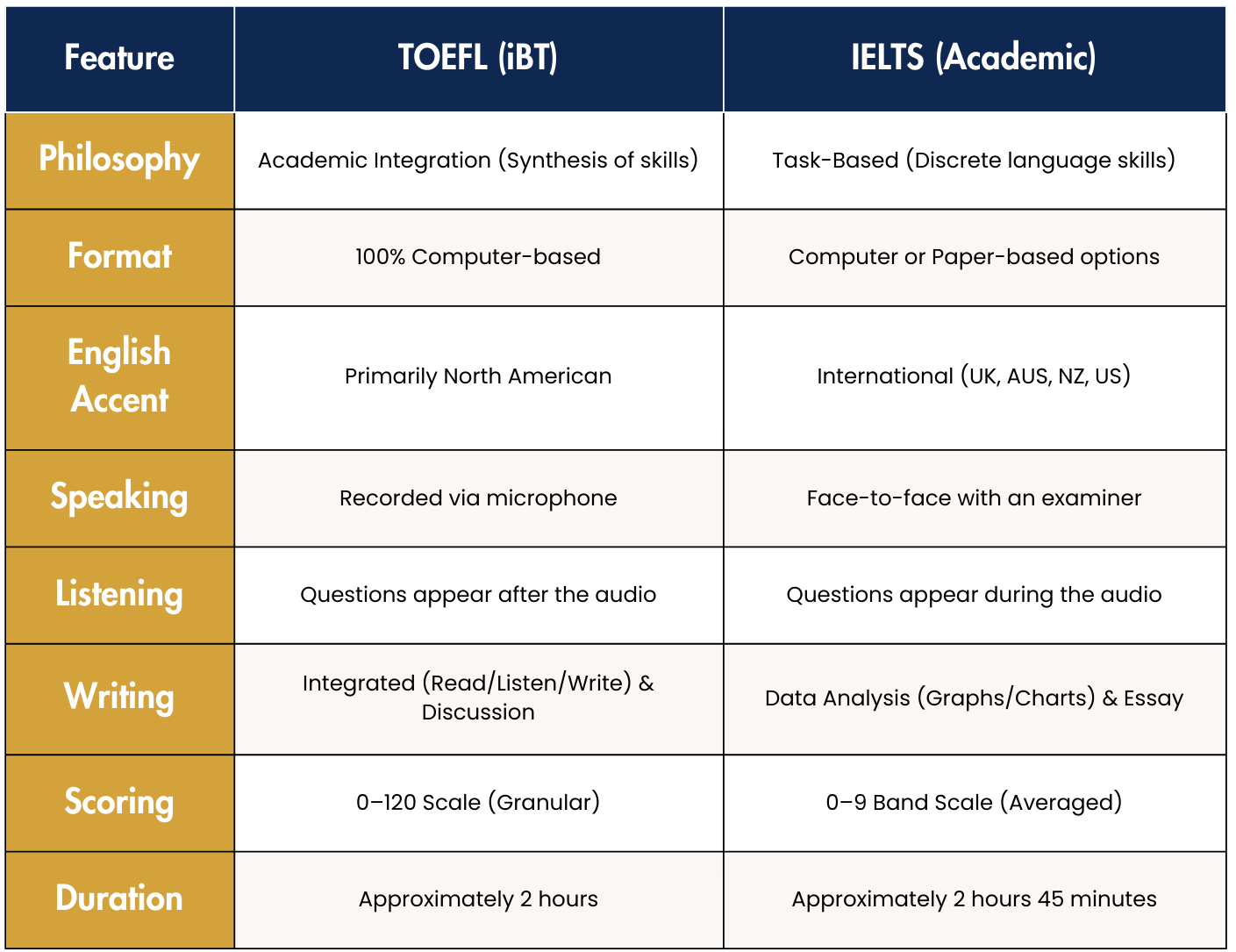
To understand the difference, we have to look at the philosophy behind the design of these exams. The TOEFL (Test of English as a Foreign Language) is administered by ETS, a U.S.-based organization. It measures your ability to integrate listening, reading, speaking, and writing to perform academic tasks. It feels very much like a day in the life of a university student. You might listen to a lecture, read a passage from a textbook, and then speak about how they relate.
On the other hand, the IELTS, or International English Language Testing System, is managed by the British Council and IDP Education. It is often perceived as being more “international” because it includes a variety of accents, including British, Australian, and American. While it is also academic, it tends to use a broader range of question types. If you prefer a test that feels like a series of smaller, distinct tasks rather than one long, integrated academic session, this might be the one for you. Ultimately, the most critical factor while choosing is understanding your specific university applications and their unique criteria.
Breaking Down the Formats
The format of the exam is usually the biggest “make or break” factor for students. Let’s look at how they actually function on test day.
The Reading Section
The TOEFL Reading section consists of three to four academic passages followed by multiple-choice questions. It primarily tests your grasp of rhetorical structure and university-level vocabulary.
The IELTS reading section is a bit more diverse. You might encounter “match the heading” questions, “true/false/not given” tasks, or gap-fill exercises. For some, the variety makes it more interesting. For others, the complexity of the question types makes it more stressful than the straightforward multiple-choice format of the American counterpart.
The Listening Section
There is a significant difference in how you process information here. In the TOEFL, you listen to long lectures and conversations first, taking notes as you go. You only see the questions after the audio has finished. This tests your memory and your ability to identify key concepts under pressure.
Conversely, the IELTS requires you to answer questions while the audio plays. This demands intense multitasking: you must read, listen, and write simultaneously. Missing a single word can lead to a ‘domino effect’ of missed answers. You have to read, listen, and write all at the same time. If you miss a word, it can be difficult to catch up, whereas, in the other test, your notes can save you.
The Speaking Battle: Human or Microphone?
If the idea of talking to a computer makes you nervous, you aren’t alone. The TOEFL Speaking section is entirely digitized; you speak into a microphone while a timer counts down on the screen.
You wear a headset, read a prompt or listen to a conversation, and then speak into a microphone. A digital timer counts down on the screen. It can feel a bit clinical and cold, but for introverts who find face-to-face interviews intimidating, this is often a relief. There is no one to judge your body language or your eye contact.

The IELTS favors a more organic approach. You engage in a three-part, face-to-face conversation with an examiner. This format rewards natural communicators who benefit from non-verbal cues like nodding or smiling.
You engage in a three-part conversation that starts with basic questions about your life and moves into a more abstract discussion. This format rewards those who are good at natural communication. If you find that you perform better when you can see a person nodding or smiling, the IELTS is likely your best bet.
Writing Under Pressure
Writing is the final hurdle for most. In the TOEFL, you have two tasks. One is “integrated,” meaning you read a text and listen to a lecture, then write about the relationship between them. The second is a discussion-based task. It is all typed on a keyboard, so your typing speed and accuracy matter quite a bit.
The IELTS also has two tasks. Task one usually involves describing a chart, graph, or diagram. This requires a very specific type of analytical vocabulary. Task two is a classic essay. A distinct advantage of the IELTS is the availability of a paper-based version in many regions, allowing those with stronger penmanship than typing speed to write by hand.

What Tests Do Bay Atlantic University (BAU) Accept?
If you are looking to apply to Bay Atlantic University in Washington D.C., you have more options than just these two. While the TOEFL vs. IELTS choice is common, BAU recognizes that students come from diverse backgrounds and may have taken different paths to prove their proficiency.
Below is a detailed table of the scores required for admission to various programs at BAU.
| Test Name | Undergraduate (Min) | Graduate (Min) |
| IELTS | 5.5 | 6.0 |
| TOEFL (iBT) | 70 | 80 |
| TOEIC | 650 | 700 |
| Duolingo (DET) | 75 | 90 |
| Pearson (PTE) | 48 | 53 |
| BAU Proficiency | 70 | 75 |
| Mentora College | Pass 400C | Pass 500C |
Note that the BAU English Proficiency Test is an excellent alternative if you are already on campus or nearby, as it is specifically designed to align with the university’s academic expectations.
✅ Request information on BAU's programs TODAY!
Practical Considerations: Logistics and Scoring
When deciding on TOEFL vs. IELTS, don’t forget the practical side of things. How much does it cost? Where is the nearest testing center?
The TOEFL is scored out of 120 points, with 30 points available for each of the four sections. This provides a very granular look at your skills. If you are slightly better at reading than speaking, those extra points in the reading section can help pull up your total score.
The IELTS utilizes a ‘Band’ system (0–9). Because your final score is an average of the four sections, a lower score in one area (e.g., a 6.0 in Writing) can pull down your overall band, even if you excelled elsewhere.
In terms of availability, both standardised tests are offered almost every week in major cities. However, the computer-delivered IELTS is becoming more common, which has shortened the wait time for results to just a few days. TOEFL results typically take about six to ten days to arrive in your inbox.
Which One Suits Your Personality?
Beyond the technical details, your personality plays a huge role. Are you an “integrated” thinker? Do you enjoy synthesis and seeing how different pieces of information fit together? If so, the TOEFL will likely feel more natural to you. It rewards those who are comfortable with technology and who can stay focused on a screen for several hours.
Are you a “communicator”? Do you prefer variety and human interaction? The IELTS is often the choice for those who find the computer format too rigid. If you are good at interpreting data like charts and graphs, the IELTS writing section might actually be an advantage for you rather than a hurdle.
Another factor is the type of English you have studied. If you grew up watching American movies and using American textbooks, the North American accents in the TOEFL will feel like home. If you are more accustomed to British or “International” English, the IELTS will not catch you off guard with its spelling or pronunciation variations.
Making the Final Choice
At the end of the day, neither test is objectively easier or better than the other. They are simply different tools used to measure the same thing. Many students find that taking a full-length practice test for both is the best way to decide. You might find that you naturally score higher on one simply because the question style clicks with your brain.
When looking at the TOEFL vs. IELTS landscape, remember that the goal is to get into your dream program. Whether you choose the computer-centric American test or the person-to-person British alternative, the key is preparation. Familiarize yourself with the specific instructions of your chosen test so that on exam day, the only thing you have to worry about is the English language itself.
Conclusion
Whether you are leaning toward the academic integration of the TOEFL or the conversational feel of the IELTS, both paths lead to the same destination: a successful university career. Universities like BAU provide clear guidelines to help you understand exactly what is needed for your specific program. Take a deep breath, pick the format that makes you feel most confident, and start your preparation. Your future in international education is well within reach.

FAQ: English Proficiency Essentials
Which is better, TOEFL or IELTS?
Neither is better; it depends on your preference. The TOEFL is entirely computer-based and uses North American English, while the IELTS offers a face-to-face speaking interview and uses a variety of international accents.
Does BAU accept Duolingo or only TOEFL vs. IELTS?
BAU accepts several exams, including Duolingo, TOEIC, and Pearson PTE. You can also take the BAU English Proficiency Test on campus or complete a course at Mentora College.
How long are English proficiency test scores valid?
For almost all institutions, your English proficiency scores are valid for two years from the date of the exam. After two years, you will need to retake the test.
Is the Speaking section in IELTS easier than TOEFL?
If you prefer talking to a real person, IELTS may feel easier. If you get nervous during interviews and prefer talking into a microphone without someone watching you, TOEFL is likely a better fit.