
Table of Contents
- What Is CEFR and Why Does It Matter?
- CEFR English Proficiency Levels from A1 to C2
- How Does CEFR Connect to English Exams?
- Practical Ways To Improve Your English
- Study Tips by Level
- Mentora College in Washington, D.C.: Your Pathway to University-Level English
- Conclusion: Turning Your CEFR Level into Action
- Frequently Asked Questions (FAQ) About CEFR
Knowing your English level is more than just a number. It affects which programs you can apply to, how comfortable you feel in class, and how confident you are when you speak, write, and study in English.
For international students, especially those who want to study in the United States, understanding CEFR English proficiency levels is a great starting point. It helps you answer a simple question: Am I ready for university-level English, or do I need an English program first?
In this guide, we will walk through what CEFR is, what each level from A1 to C2 means, and how you can improve your English over time.
What Is CEFR and Why Does It Matter?
CEFR in Simple Terms
CEFR stands for Common European Framework of Reference for Languages. It is a global standard that describes language proficiency levels in a clear, practical way.
Instead of focusing only on grammar or vocabulary, CEFR focuses on what you can actually do with the language:
-
Can you introduce yourself and ask basic questions?
-
Can you follow a lecture and take notes?
-
Can you write a structured essay or report?
By looking at real-life skills in speaking, listening, reading, and writing, CEFR makes it easier to see where you are now and what you need to improve next.
CEFR English Proficiency Levels from A1 to C2
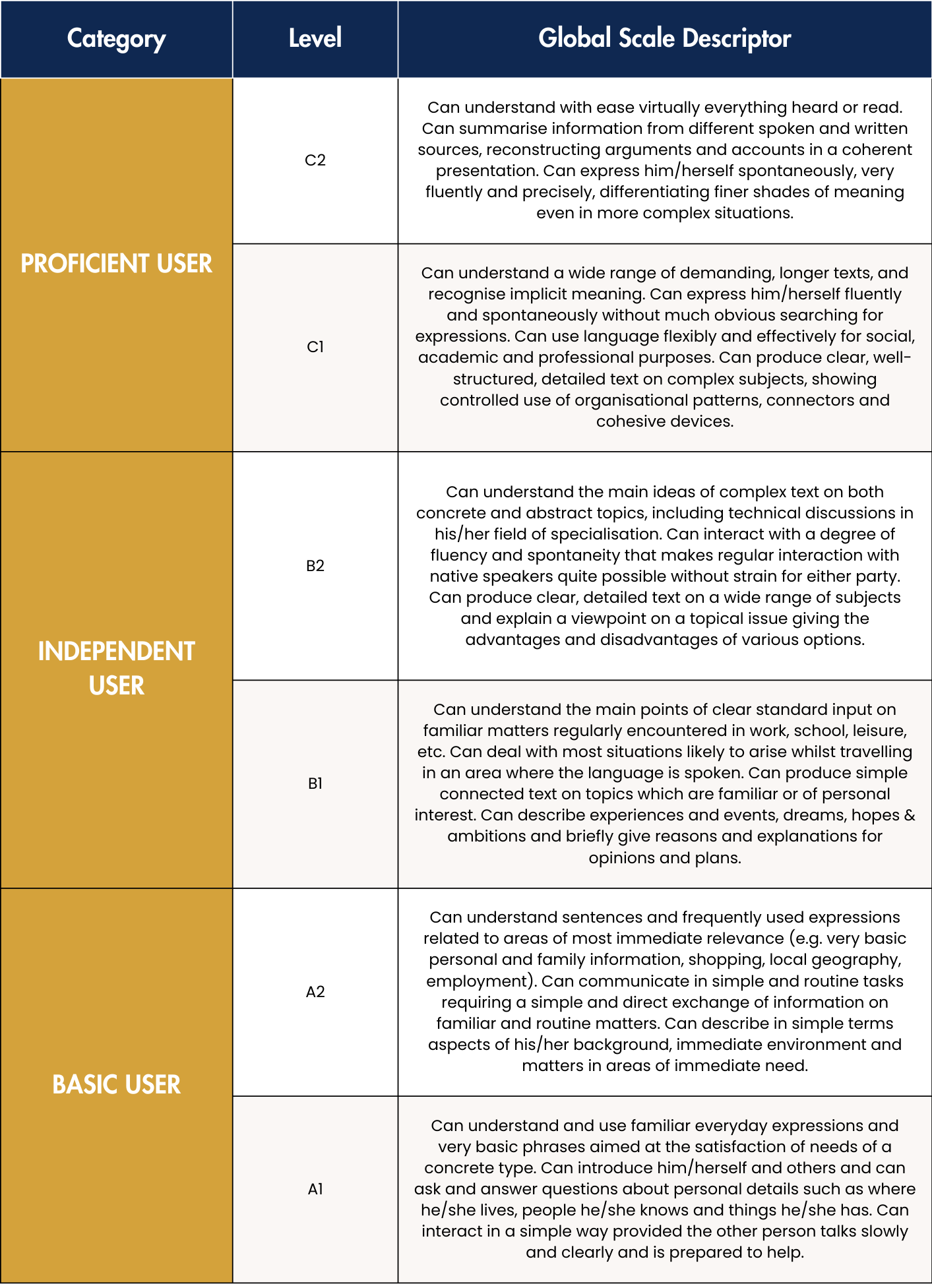
CEFR divides English proficiency levels into three main groups. Each letter (A, B, C) is then split into two levels (1 and 2), making six CEFR English proficiency levels in total. Let us look at what each English proficiency level means in practice.
A1 – Beginner: Your First Steps in English
At A1, you are just starting your English journey.
You can:
-
Understand and use very basic words and phrases
-
Introduce yourself and ask simple questions (name, nationality, etc.)
-
Understand slow and clear speech if the topic is very familiar
At this level, you need a lot of support: repetition, visuals, gestures, and patience. The goal is to build confidence and show you that English is something you can use, not just study.
A2 – Elementary: Handling Simple Everyday Situations
At A2, you can manage simple and routine tasks.
You can:
-
Talk about your family, hobbies, shopping, and your city
-
Understand short, simple texts, such as messages, notices, or basic emails
-
Write short notes and simple sentences about familiar topics
You are still limited, but you can survive everyday situations in English if people speak slowly and clearly. You are moving from memorizing fixed phrases to creating your own simple sentences.
B1 – Intermediate: Becoming More Independent
At B1, your English proficiency level allows you to be more independent.
You can:
-
Understand the main points of clear speech about school, work, and free time
-
Handle most situations that may happen while traveling or living abroad
-
Describe experiences, plans, and opinions in simple connected language
-
Write basic essays, emails, and paragraphs
This is often the turning point level. You can participate in conversations and follow simpler lectures, but academic study will still feel challenging.
B2 – Upper-Intermediate: Ready for Academic Challenges
At B2, you can interact more naturally and handle more complex content.
You can:
-
Understand the main ideas of complex texts, especially on familiar subjects
-
Follow lectures with the help of slides or notes
-
Take part in group discussions and defend your opinions
-
Write clear, detailed texts such as essays or reports
Many universities look for a B2 English proficiency level (or similar) for undergraduate study. At this level, you can manage academic life with support, especially if you continue to improve your academic vocabulary and writing skills.
C1 – Advanced: Confident Academic and Professional English
At C1, you can use English flexibly and effectively.
You can:
-
Understand long, demanding texts and recognize implied meanings
-
Express ideas fluently without much searching for words
-
Use language effectively for study, work, and social purposes
-
Produce clear, well-structured, detailed writing on complex topics
This level is very suitable for graduate programs, research, presentations, and professional environments where English is used every day.
C2 – Proficiency: Near-Native Control
C2 is the highest CEFR English proficiency level.
You can:
-
Understand almost everything you hear or read
-
Summarize information from different sources and build strong, logical arguments
-
Express yourself very precisely, even about subtle differences in meaning
-
Adapt your tone and style to any audience or situation
Not all universities require C2 for admission, but it represents near-native, highly advanced English. It is ideal for complex research, leadership roles, or careers that demand very high-level communication.
How Does CEFR Connect to English Exams?
CEFR Levels and Test Scores
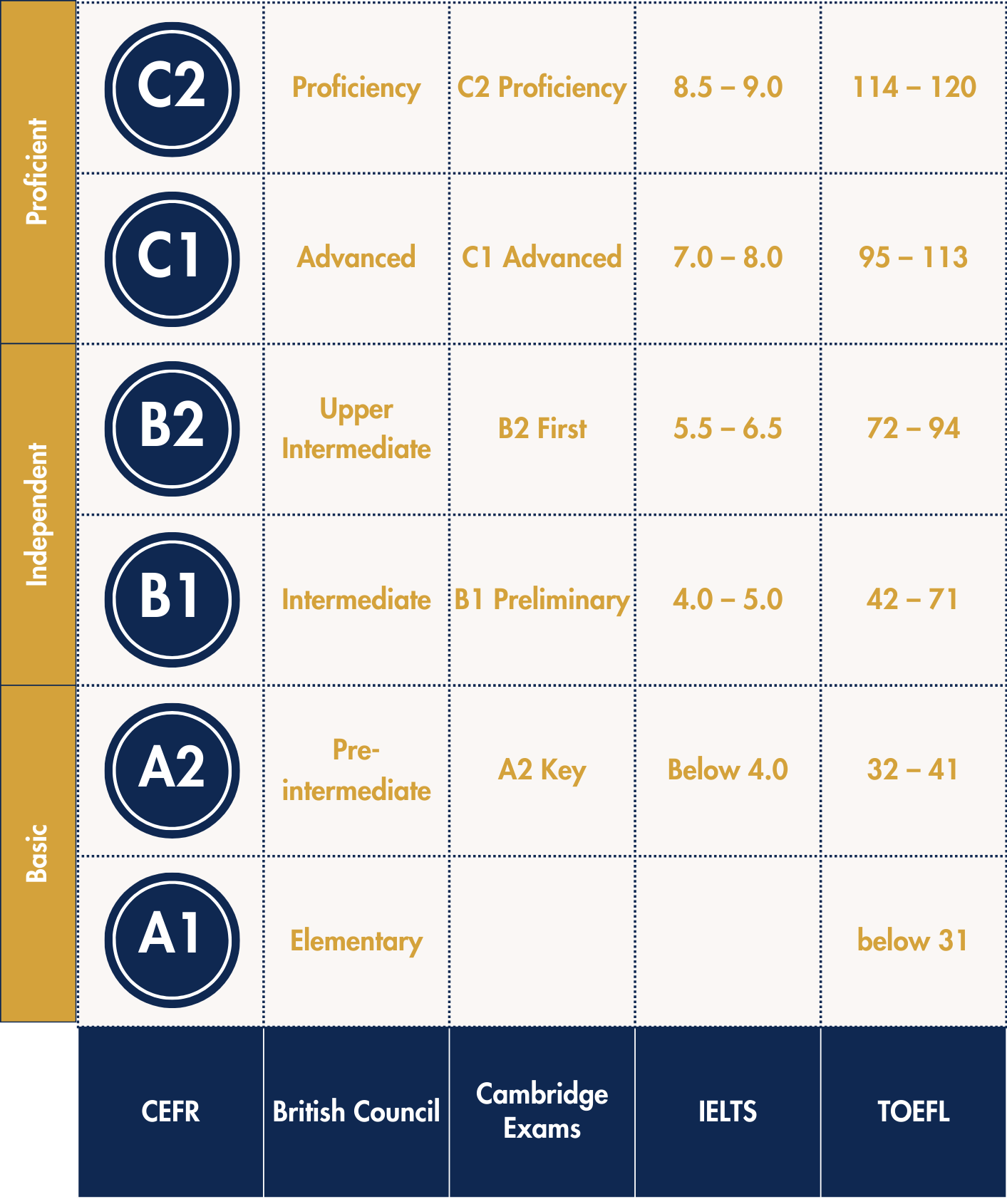
CEFR itself is not a test. Instead, many standardized exams (such as IELTS, TOEFL, etc.) use CEFR to describe what their scores mean.
In simple terms:
-
The exam gives you a score
-
CEFR gives you a level that explains what you can do
Exam providers often publish their own charts showing how scores relate to CEFR English proficiency levels. While the exact numbers can differ, the idea is the same: to show if you are around B1, B2, C1, and so on.
The table below shows how CEFR English proficiency levels relate to popular English Proficiency Exam score ranges. It’s based on publicly available charts from the British Council, Cambridge English, and ETS, and is meant as an approximate guide rather than an official equivalence.
Why CEFR Is Helpful for Students
CEFR makes it easier to:
-
Set clear goals (for example: “I want to move from B1 to B2 in one year”)
-
Choose the right English course based on your current level
-
Understand university language requirements in a more transparent way
Instead of just saying “I scored X,” you can say “I am at B2 level,” which many schools and employers understand immediately.

Practical Ways To Improve Your English
To improve your CEFR level, you need a mix of input and output. Both are important and support each other.
Input (what you receive):
-
Watch series, films, or lectures with English subtitles.
-
Listen to podcasts, songs, and videos on topics you genuinely enjoy.
-
Read short articles, blog posts, or graded readers that match your level.
This kind of input helps you see and hear English in real use, not just in a textbook.
Output (what you produce):
-
Speak as much as possible with classmates, teachers, or language partners.
-
Write short texts every day, journal entries, emails, social media captions, or summaries.
-
Record yourself speaking, then listen back and notice pronunciation, pauses, or mistakes you want to improve.
The more you use the language, the faster your English proficiency grows.
Progress Takes Time
Going from one English proficiency level to the next does not happen in a week. It takes regular practice, feedback from teachers, and constant exposure to the language in real situations.
✅ Request information on BAU's programs TODAY!
Progress is rarely a straight line. Very often, it looks like this:
You feel “stuck” for a while. Nothing seems to change, and you might wonder if you are improving at all.
Then suddenly, you realize you understand more than before. You can follow conversations more easily or catch details in a movie that you used to miss.
After that, you start using new words or grammar structures without even thinking about them. They simply become part of how you speak and write.
That “stuck” feeling is actually normal. It usually means your brain is processing and consolidating what you have already learned, preparing you for the next jump in progress.

Study Tips by Level
Your study strategies should change slightly as your level increases.
A1–A2 (Beginning Stages)
At these levels, focus on building a strong base.
-
Focus on core vocabulary and simple grammar structures.
-
Use visuals, flashcards, and lots of repetition to remember new words.
-
Do not worry too much about mistakes; your main goal is to communicate and be understood.
B1–B2 (Becoming Independent)
Here, you already understand quite a lot, so it’s time to expand.
-
Read more and start writing longer texts, such as paragraphs or short essays.
-
Join conversation clubs, language exchanges, or online speaking groups.
-
Begin building academic vocabulary to prepare for future university studies.
C1–C2 (Advanced and Proficient)
At these levels, you refine and polish your English.
-
Work on accuracy, style, and natural-sounding language.
-
Practice essays, reports, presentations, and research-style writing.
-
Engage with complex topics such as global issues, academic articles, or subjects from your future field of study.
Step by step, these habits help you move from one CEFR level to the next—and feel much more confident using English in real life.
Choosing the Right English Program for Your CEFR Level
Choosing the right English program starts with understanding your current English proficiency level and finding a school that respects that. A strong ESL program will use CEFR-based placement tests to place you in the right level, rather than guessing or grouping everyone together. It should clearly explain what you will be able to do at the end of each course, so you know how your skills will improve from level to level.
Good programs are built and delivered by qualified, experienced instructors who understand the challenges of learning English as a second language. Just as importantly, they give you many chances to practice speaking, listening, reading, and writing in real situations—not only through grammar exercises, but also through projects, discussions, and real-life tasks.
Why Location Matters
Where you study can be just as important as how you study. Learning English in an English-speaking city gives you daily practice outside the classroom. You interact with people in shops, cafés, and public services; you join events, clubs, and activities; and you naturally encounter different accents, cultures, and ways of speaking.
This constant exposure means English is not just something you study a few hours a week—it becomes part of your everyday life. Over time, this makes a big difference in how fast and how naturally your English improves and how comfortable you feel using it at any English proficiency level.

Mentora College in Washington, D.C.: Your Pathway to University-Level English
Mentora College in Washington, D.C. is an English language school that welcomes international students from around the world. As part of a global education network that includes Bay Atlantic University, Mentora is designed for learners who use English as a second language and want to build strong skills for both academic study and everyday communication.
Mentora College in Washington, D.C. offers a full range of CEFR-aligned English programs, from beginner to advanced. Students can choose full-time Intensive or Semi-Intensive English Programs, then build on their skills with Advanced Elective Courses in areas like academic writing, TOEFL preparation, and American culture.
For different needs and stages, Mentora also provides Continuing Education options (Life Skills English, Business English, Citizenship, TEFL, exam prep) and a Youth Program that combines ESL with STEM activities for ages 11–17. Together, these programs give learners practical language skills and a clear path toward studying or living in the United States.
If you are ready to take the next step in your English journey, you can explore Mentora College’s programs and apply here.