Table of Contents
- What Are Cybersecurity Frameworks?
- The 5 Core Cybersecurity Frameworks Every Student Should Know
- Specialized Standards That Support Cybersecurity Frameworks
- Why Employers Value Knowledge of Cybersecurity Frameworks
- Choosing a Career Path Through Cybersecurity Frameworks
- Building Your Certification Path
- Conclusion
Cybersecurity has become one of the fastest-growing and most essential fields in today’s digital economy. As organizations increasingly rely on technology to manage operations, store sensitive information, and deliver services, protecting digital assets has become a strategic business priority rather than simply an IT responsibility. From financial institutions and healthcare providers to government agencies and universities, organizations depend on structured approaches to cybersecurity to reduce risk and respond effectively to evolving threats.
This is where cybersecurity frameworks play a vital role.
For students considering a career in cybersecurity, understanding these frameworks provides much more than technical knowledge. They offer insight into how organizations make security decisions, manage risk, and protect critical systems. When combined with industry certifications and practical experience, cybersecurity frameworks create a strong foundation for building a successful and adaptable career.
What Are Cybersecurity Frameworks?
A cybersecurity framework is a structured set of guidelines and standards that helps organizations identify, manage, and reduce cybersecurity risks. Rather than reacting to individual cyber threats as they appear, frameworks provide a repeatable strategy for building and maintaining secure systems.
A useful way to think about cybersecurity frameworks is to compare them to architectural blueprints. Just as engineers rely on detailed plans before constructing a building, organizations use frameworks to develop consistent security practices across every department. Instead of making isolated security decisions, technical teams, executives, legal departments, and management can all work toward shared security objectives using a common language.
Without a framework, organizations often adopt a reactive approach, addressing vulnerabilities only after they become problems. Frameworks replace this uncertainty with structured planning, allowing organizations to continuously evaluate risks, strengthen security controls, and improve their ability to respond to cyber incidents.
For students entering the cybersecurity profession, learning these frameworks is one of the first steps toward understanding how security operates in real-world organizations.

Why Organizations Use Cybersecurity Frameworks
Cybersecurity frameworks are more than compliance checklists. They help organizations build sustainable security programs that protect digital assets while supporting long-term business goals, going beyond simply preventing attacks to provide a structured way to manage risk, strengthen security practices, and prepare for future threats.
By following an established framework, organizations can make more informed security decisions, and strengthen their ability to respond when incidents occur. Some of the most important benefits include:
- Risk management: Frameworks give organizations a systematic way to identify risks, evaluate their potential impact, and prioritize the most effective security measures.
- Consistent security practices: Security responsibilities extend beyond IT, so frameworks establish standardized practices and shared terminology across the organization.
- Improved resilience: Cyber incidents cannot always be prevented, but frameworks help organizations prepare for, respond to, and recover from incidents while minimizing disruption.
- A proactive approach to cybersecurity: Frameworks shift organizations from reacting to problems toward continuously evaluating risk and strengthening security controls.
Ultimately, cybersecurity frameworks help organizations move from reactive problem-solving to proactive security management, a mindset that employers actively look for in cybersecurity graduates entering the workforce.
The 5 Core Cybersecurity Frameworks Every Student Should Know
Although dozens of cybersecurity standards exist, a handful of frameworks, controls, and security models have become the foundation of modern security programs. Each serves a different purpose, and understanding when and why organizations use them helps students build a clearer picture of the cybersecurity landscape.
| Framework | Primary Purpose | Best Suited For |
|---|---|---|
| NIST Cybersecurity Framework (CSF) 2.0 | Managing cybersecurity risk through a structured lifecycle | Organizations seeking a flexible, comprehensive security strategy |
| ISO/IEC 27001 | Building an Information Security Management System (ISMS) | Organizations requiring internationally recognized security standards |
| CIS Critical Security Controls | Prioritized technical safeguards for improving cyber hygiene | IT teams implementing practical security controls |
| MITRE ATT&CK | Understanding and defending against real-world attacker behavior | Security operations centers (SOCs) and threat analysts |
| Zero Trust | Eliminating implicit trust within networks through continuous verification | Cloud environments and distributed organizations |
1. NIST Cybersecurity Framework (CSF) 2.0
The NIST Cybersecurity Framework (CSF) 2.0 is a flexible approach to cybersecurity risk management that can be applied by organizations of virtually any size or industry.
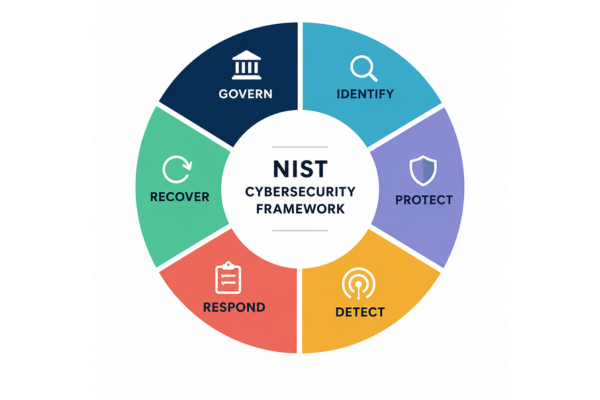
Rather than focusing on individual technologies, the framework organizes cybersecurity into six interconnected functions:
- Govern – Establishing cybersecurity policies, risk management oversight, leadership responsibilities, and strategic direction.
- Identify – Understanding organizational assets, business context, and potential risks.
- Protect – Implementing safeguards to secure systems and sensitive information.
- Detect – Identifying cybersecurity events and potential intrusions as quickly as possible.
- Respond – Taking appropriate action when a cybersecurity incident occurs.
- Recover – Restoring systems and improving resilience after an incident.
Together, these six functions provide a comprehensive structure for managing cybersecurity risk and can be used continuously as an organization’s security needs evolve. NIST CSF 2.0 is designed to be flexible and outcome-based, rather than prescribing a specific list of technologies or procedures.
2. ISO/IEC 27001
While NIST provides a flexible framework, ISO/IEC 27001 is an internationally recognized standard for building and maintaining an Information Security Management System (ISMS), rather than simply another cybersecurity framework.
Its objective is to help organizations systematically manage information security by establishing policies, conducting risk assessments, and continuously improving security practices.
Information security is often described through three fundamental principles known as the CIA Triad: confidentiality, integrity, and availability.
- Confidentiality – Ensuring information is accessible only to authorized individuals.
- Integrity – Protecting information from unauthorized modification.
- Availability – Ensuring systems and information remain accessible when needed.
Because ISO/IEC 27001 is recognized globally, organizations often pursue certification to demonstrate that they manage sensitive information responsibly and consistently, though certification does not guarantee that an organization is completely secure. For students interested in governance, compliance, consulting, or international business, familiarity with this standard can be particularly valuable.
3. CIS Critical Security Controls
Unlike broader cybersecurity management frameworks, the CIS Critical Security Controls provide a prioritized set of practical safeguards that organizations can use to strengthen their security defenses.
The CIS Controls are often described as the foundation of good cyber hygiene, focusing on the safeguards that address the most common cybersecurity risks before organizations invest in more advanced defenses.
Version 8.1 (released June 2024) includes 18 controls supported by 153 safeguards, while Implementation Group 1 (IG1) highlights the 56 essential safeguards that many organizations use as a starting point for strengthening their security posture.
Because the controls are highly practical, they are especially valuable for IT teams looking to improve security through measurable, day-to-day activities.
4. MITRE ATT&CK
MITRE ATT&CK takes a different approach to cybersecurity. Rather than providing a set of security controls or a management system, it provides a knowledge base of tactics and techniques used by real-world adversaries.
It documents these tactics and techniques throughout the different stages of a cyberattack. Security professionals use this knowledge to understand attacker behavior, improve detection capabilities, simulate realistic attack scenarios, and strengthen incident response strategies.
For students interested in Security Operations Centers (SOCs), threat intelligence, penetration testing, or incident response, MITRE ATT&CK provides valuable insight into the methods cybercriminals use and how defenders can prepare for them.
5. Zero Trust
Zero Trust represents a significant shift in cybersecurity thinking. Rather than a traditional cybersecurity framework, it is best described as a security model or approach. Instead of assuming that users or devices inside an organization’s network can automatically be trusted, Zero Trust operates on a simple principle:
Never trust. Always verify. This phrase captures the mindset behind Zero Trust, though it isn’t the complete definition of the model.
Instead of automatically trusting users or devices based on their location within a network, Zero Trust requires organizations to continuously evaluate access requests based on identity, device security, context, and other risk factors. This approach is especially relevant in cloud, hybrid, and remote work environments, where traditional network boundaries are less meaningful.
By continuously validating identities and limiting unnecessary access, Zero Trust helps organizations reduce the risk of unauthorized activity and strengthen overall security.

Specialized Standards That Support Cybersecurity Frameworks
While cybersecurity frameworks provide broad approaches for managing cybersecurity risk, organizations may also need to follow industry-specific standards, regulations, and assurance requirements. These requirements address specific types of data, systems, or business activities.
✅ Request information on BAU's programs TODAY!
Common industry-specific standards include:
- SOC 2 – Used by service organizations, including many SaaS and cloud providers, to demonstrate that controls related to security and other Trust Services Criteria are suitably designed and, for Type II examinations, operating effectively over a period of time.
- PCI DSS – A security standard designed to protect payment card data and reduce the risk of payment card fraud and data breaches. It applies to organizations involved in storing, processing, or transmitting cardholder data.
- HIPAA – A U.S. federal law that includes requirements for protecting patients’ protected health information (PHI), including administrative, physical, and technical safeguards under the HIPAA Security Rule.
- CMMC 2.0 – The Cybersecurity Maturity Model Certification program establishes cybersecurity requirements for applicable organizations in the Defense Industrial Base (DIB) that handle Federal Contract Information (FCI) or Controlled Unclassified Information (CUI).
Although these standards, regulations, and programs address different industries and requirements, they can complement broader cybersecurity frameworks by helping organizations meet specific security, privacy, and compliance obligations.

Why Employers Value Knowledge of Cybersecurity Frameworks
Technical skills are essential in cybersecurity, but employers also value professionals who understand how security decisions affect an organization’s risks, operations, and business goals.
Cybersecurity frameworks help professionals move beyond implementing individual security tools. They provide structured approaches for assessing risk, prioritizing security investments, and communicating security priorities across an organization.
Organizations commonly use cybersecurity frameworks to:
- Perform gap analysis by comparing current security practices with recognized frameworks to identify weaknesses and prioritize improvements.
- Map technical risks to business risks, helping decision-makers understand how cybersecurity issues can affect operations, finances, customer trust, and compliance.
- Strengthen security practices by applying practical safeguards such as maintaining accurate asset inventories, using multi-factor authentication, and implementing appropriate access controls.
For students entering the workforce, understanding cybersecurity frameworks demonstrates more than technical knowledge. It shows the ability to think strategically about security, risk, and business needs.
Choosing a Career Path Through Cybersecurity Frameworks
Cybersecurity offers a wide range of career paths, from technical roles in security operations to positions focused on governance, risk, and compliance. Different roles require different skills, so some frameworks and security models may be more relevant depending on your career goals.
| Career Path | Relevant Frameworks and Models | Why They Matter |
|---|---|---|
| Security Analyst / SOC Analyst | NIST CSF, MITRE ATT&CK, CIS Controls | Detect, investigate, respond to, and recover from cyber incidents. |
| Penetration Tester | MITRE ATT&CK, CIS Controls | Simulate attacks and recommend practical security improvements. |
| Governance, Risk & Compliance (GRC) | ISO/IEC 27001, NIST CSF | Develop security policies and manage organizational risk. |
| Cloud Security | Zero Trust, NIST CSF | Protect cloud and hybrid environments through identity-based access controls, risk management, and continuous security practices. |
These are illustrative starting points rather than the only frameworks relevant to each role — many positions draw on multiple frameworks and models depending on the organization. Understanding which frameworks and security models are relevant to different cybersecurity roles can help students make more informed decisions about their education, certifications, and professional development.

Building Your Certification Path
Professional certifications can help students validate their knowledge and demonstrate foundational or specialized skills. Rather than collecting credentials without a clear goal, students can build their certification path gradually as their knowledge, skills, and experience grow.
Beginner: Building Fundamental Knowledge
Students new to cybersecurity should begin by developing a strong understanding of core concepts and terminology.
Recommended learning and certifications include:
- Cisco Networking Academy – Introduction to Cybersecurity
- Cisco Certified Support Technician (CCST) Cybersecurity
- ISC2 Certified in Cybersecurity (CC)
These learning opportunities and certifications introduce foundational concepts such as cybersecurity threats, risk management, security principles, and defensive practices, giving students a foundation for more advanced study.
Entry-Level: Developing Practical Skills
After building a solid foundation, students can begin preparing for entry-level cybersecurity positions.
Key focus areas include:
- Threat intelligence
- Vulnerability management
- Incident response
A Junior Cybersecurity Analyst learning path can help students apply foundational concepts to practical scenarios, including threat detection, vulnerability management, and incident response. Pairing this coursework with hands-on labs and practical projects is equally important, since certifications alone are not a substitute for practical experience.
Intermediate: Specializing in Security Operations
Students who want to specialize in areas such as security operations or offensive security can consider certifications aligned with their career goals, such as:
- CCNA Cybersecurity (formerly CyberOps Associate)
- Certified Ethical Hacker (CEH)
These certifications focus on Security Operations Centers (SOCs), threat detection, incident response, and offensive security techniques, though not every certification covers all of these areas equally.
Advanced: Preparing for Leadership
Experienced professionals often pursue advanced certifications such as:
- ISC2 SSCP
- CISSP
SSCP requires one year of cumulative, paid work experience in at least one of its seven domains (or a qualifying cybersecurity degree), while CISSP requires five years of cumulative experience across at least two of its eight domains, which can be reduced by one year with a relevant degree. Candidates without the required experience can still sit either exam and become an Associate of ISC2 while they build the necessary work experience. Because many advanced certifications have professional experience requirements, students can use their academic experience and entry-level certifications as a foundation while building the work experience needed for more advanced credentials.
Conclusion
Cybersecurity is about much more than learning security tools or earning certifications. Cybersecurity frameworks provide organizations with structured approaches to managing risk, protecting sensitive information, and improving their ability to respond to security incidents.
For university students, understanding these frameworks provides valuable insight into how organizations approach cybersecurity and make security decisions. Certifications can help demonstrate growing technical knowledge, while hands-on projects, laboratory experience, and internships give students opportunities to apply what they have learned in practical settings.
Whether your goal is to become a security analyst, penetration tester, cloud security specialist, or governance professional, understanding cybersecurity frameworks can help you make more informed decisions about your education and career path. Combined with practical experience, certifications, and continuous learning, this knowledge can help you build the skills needed to contribute to the security of the digital systems organizations rely on every day.